Blog · Oct 21, 2026 · By Velocity11
The people building AI expect a different 2030 than you do

Ask the public how fast AI is coming, then ask the people who build it. You will get two very different futures. Anthropic just published the difference in numbers: it compared a nationally representative survey of 10,980 US adults, fielded by Morning Consult in August, with an internal poll of 1,334 Anthropic employees. The result is what they call the AI expectations gap. [1]
Where the gap is biggest
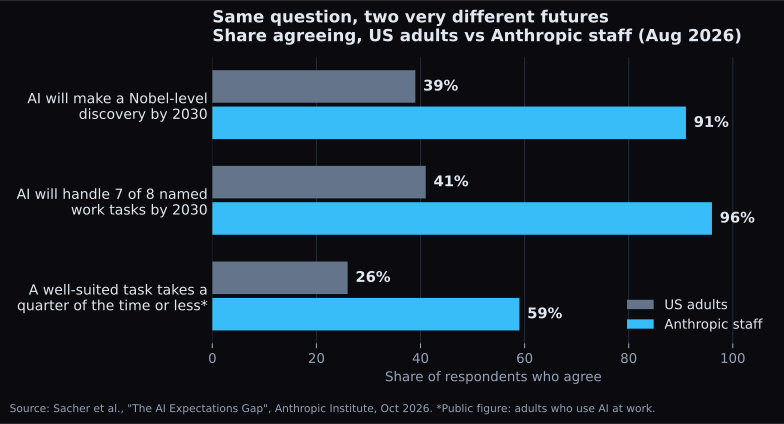
The two groups mostly agree on what AI can do today. They disagree about tomorrow. By 2030, 39% of US adults expect AI to be able to make a Nobel-level scientific discovery. Among Anthropic staff, that number is 91%. Asked about eight work tasks, from writing routine emails to running scientific studies, 41% of US adults expect AI to handle at least seven of them by 2030 - among staff, 96%. And depending on the task, between 19% and 40% of US adults say AI will never be able to do it. At most 2% of staff say never. [1]
Your own job
The gap gets personal here. On average, Anthropic staff expect AI to be able to do 75% of their own current work hours by 2030. The average US worker says 28% - and only 1 in 20 thinks AI could do 80% or more of their job. Staff also report much bigger speedups today: 85% say a well-suited task takes half the time or less with AI, and 59% say a quarter of the time or less. Among US adults who use AI at work, 26% say a quarter of the time or less - and 29% say it takes just as long or longer. [1]
One finding surprised us. Both groups reason about jobs the same way: people who expect AI to do more of their own work also forecast higher unemployment, at nearly the same rate in both groups. US workers who expect AI to handle 80% or more of their job forecast 12.2% unemployment in 2030 on average - above the peak of the 2008 financial crisis, from 4.2% today. The disagreement is not about what widespread AI would mean. It is about whether it is coming. [1]
Inside the lab
Two more numbers show how different the view is from inside. Staff estimate that AI already does 51% of the work of building a frontier AI model (median answer), and expect that to reach 80% by the end of 2027 and 95% by the end of 2030. Yet 95% of them also expect Anthropic to keep hiring over the next 12 months, with the median person expecting headcount to grow 66%. Expecting AI to do most of your work and expecting your employer to hire more people are, at least inside one AI lab, the same belief. [1]
The gap closes with use
The most useful finding for everyone else: expectations track experience. Among US adults who use AI regularly at work, 56% expect AI to handle at least 7 of the 8 named tasks by 2030 - well above the 28% among people who have never used an AI tool, and much closer to the staff view of 96%. The gap between the public and the builders is largely a gap between people who use AI daily and people who do not. [1]
Fair warnings
- Anthropic surveyed its own employees and published the comparison itself. A future where AI advances extremely fast is good for Anthropic's business. Treat the staff numbers as what insiders believe, not as evidence about what will happen. [1]
- Beliefs are not predictions. The paper says so itself: forecasts about AI's future vary widely and are fiercely debated. Neither group has a crystal ball - the staff were also the people who did not see every past surprise coming. [1]
- Method limits, stated by the authors: the public survey was an online opt-in panel (it misses adults without internet access, weighted to be representative otherwise), the staff poll was unweighted, and the hiring and model-building figures are staff members' personal views, not Anthropic's plans or forecasts. [1]
- The numbers are already moving. Morning Consult re-ran the survey in September and the public share expecting a Nobel-level discovery by 2030 rose from 39% to 44% in about a month. The report uses the August numbers throughout. [1]
What to do with this
- Weight opinions by hands-on use. When someone tells you what AI will or will not do, the first question is "how much do you use it?" The survey shows experience is the single biggest divider.
- Expect your own expectations to move. If you start using AI more at work, the data says your view of 2030 will likely shift toward the builders' view. That is worth knowing before you make long plans based on today's gut feeling.
- Do not plan around either extreme. The public's median answers still imply unusually fast economic growth (5.4% in 2030, in the authors' model). Even the "skeptical" scenario is not business as usual.
Try it this week
Ask two people how much of their job AI could do in five years: one who uses AI daily, one who never does. Then ask each how they formed that view. You will see the expectations gap in your own contacts list.
We use AI to help write these posts, and we say so on every one: this post was written with AI help and reviewed by a person.
Which future do you believe - the public's or the builders'? Tell us on Instagram @velocity11ai.
Source
[1] Sacher, Cotter, Jones, Korinek, McCrory, "The AI Expectations Gap: Public and Frontier Lab Views on AI's Impact on Work", Anthropic Institute, Oct 2026. anthropic.com/research/ai-expectations-gap
The hero image was made with AI. The chart was drawn by Velocity11 from the published numbers. This post was written with AI help and reviewed by a person.