Blog · Oct 30, 2026 · By Velocity11
80% of surveyed leaders at big US companies say AI pays off. 28% say it pays off big.

Here is a pair of numbers worth sitting with. In the 2026 AI Adoption Report from Wharton and GBK Collective, 80% of US enterprise leaders say their AI investments are already producing positive returns. But only 28% call those returns strongly positive. Four in five report getting something back; far fewer report a strong return. So the useful question is no longer "does AI pay off" but "what do the companies reporting strong returns actually look like" - and this year the study answers that in unusual detail. [1]
The study
This is the fourth annual study from Wharton Human-AI Research and GBK Collective, published October 13, 2026. About 1,400 US respondents took the 15-minute online survey between July 9 and July 29, 2026. Comparisons with earlier years use the managers-and-above base (n=1,007), and for the first time the study also polled entry- and mid-level employees, so it can compare what leaders report with what their teams experience. [1][2]
What the strong-return group has in common
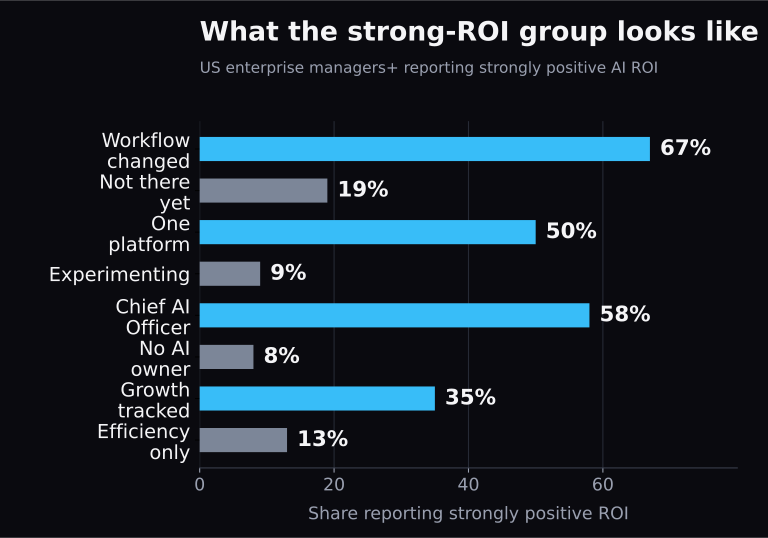
The most common way departments judge AI is hours saved - 40% use it, while net-new revenue is the least-used major measure at 27%. Among departments that also track at least one growth measure (net-new revenue, sales conversion, output volume or customer satisfaction), 35% report strongly positive returns. Among those measuring efficiency alone, 13% do. [2]
Settled approaches show up in the strong group too. Where a company has newly appointed a Chief AI Officer, 58% report strongly positive returns, against 24% where AI was added to an existing executive's role and 8% with no such role or plans. Where the company has standardized on one approved AI platform, 50% report strongly positive returns, against 9% of those still experimenting without a defined approach. [1]
The strongest pattern is workflow change. The report defines transformation as AI fully embedded in core processes, agents in use, and workflows significantly changed; only 20% of departments have attained all three of those transformation milestones, but 67% of those that have report strongly positive returns, against 19% of the rest. Departments with strong returns are also more likely to have changed their management structure (64% vs 47%), to monitor AI use (92% vs 74%), to include AI in performance reviews (87% vs 65%) and to report adequately trained employees (91% vs 73%). [1][2]
The awkward part about AI agents
Two-thirds of departments say they use AI agents, but only 17% let an agent complete a task without a person approving each step. GBK's Brian Smith calls this the supervised middle: "Most companies are sitting in a supervised middle, paying for autonomy and then reviewing every action, and that is where returns are weakest." The report adds two related findings: where agents may take irreversible financial or legal actions, 29% of departments have transformed their workflows against 13% of those allowing agents more limited responsibilities, and departments that monitor agents automatically have transformed at 24% against 9%. [1]
Read that carefully, because it is easy to over-read. These are associations in self-reported data: this survey cannot say that approving each step is what holds returns back, and it would be a mistake to conclude that oversight is the problem. The pattern the report itself points to is not "remove the human" but consequential work paired with automated monitoring - oversight by exception rather than by keystroke. Where the boundary should sit depends on what a mistake would cost, and no survey can decide that for your business.
What leaders say vs what employees say
For the first time, the study polled entry- and mid-level employees alongside leaders, and the two respondent groups give noticeably different pictures. Leaders report organizational alignment - adequate training, a clear long-term vision, real choice in how people use AI - at 39%; only 26% of entry- and mid-level employees say the same. 78% of leaders say employees receive adequate AI training; 56% of employees agree. 79% of leaders say people are confident using AI daily, against 62% of employees; on leadership setting out a clear long-term AI vision, it is 79% against 64%. These are separate respondent groups, not necessarily people at the same companies - so the numbers show how differently the two levels tend to see things, not a proven mismatch inside any one firm. [2]
And something shifted in mood this year. Daily use among leaders jumped 16 points to 62%, yet "excited" fell 8 points to 51% while "cautious" rose 7 to 44%, "skeptical" 8 to 25% and "worried" 5 to 16%. It is the first year in the study where usage and enthusiasm move in opposite directions. Employees, for their part, are not anti-AI: 73% of entry- and mid-level employees say it has had a positive effect on their own role, and 84% of those who use it say it saves them time. [2]
Fair warnings
- This is one self-reported online survey of US enterprises, run in July 2026 with about 1,400 respondents. It polled leaders and employees at large companies - not small businesses. A ten-person firm is not in this data, and the returns reported here are what respondents say, not audited figures. [2]
- Every comparison in this post is an association. Companies already doing well may find it easier to reorganize, name an AI owner or settle on one platform - the survey cannot say which came first. The report's own word is "correlates", and its authors frame these as markers, not recipes. [1]
- The study is co-produced by GBK Collective, a commercial research firm whose business includes AI adoption research; Wharton directs the research agenda and publishes the report. Worth knowing when a study about AI returns also recommends deeper integration. [1]
What to do with this
What follows is our read for a small business - judgment, not the study's prescription. It surveyed enterprises, the findings are associations, and none of it is a guarantee.
- Measure one outcome that isn't hours. Departments tracking a growth measure report strongly positive returns at 35% against 13% for efficiency-only tracking. For a small business the translation is simple: pick one number the tool should move - sales, repeat customers, quotes sent - and check it monthly. [2]
- Name one owner. You do not need a Chief AI Officer; you need one named person, usually you, who decides which tools stay and which go. The pattern in the strong-return group is a settled approach, not a specific job title. [1]
- Match the review to the risk. Do not read this survey as proof that approvals hurt returns - it cannot show that. Our read: for reversible, low-stakes tasks, reviewing the finished work afterwards may be enough; for anything touching money, contracts or customers, keep a person approving each step. The report's own framing points the same way: consequential work, monitored automatically - not unmonitored.
- Ask, don't assume, on training and direction. In this survey, 78% of leaders say employees receive adequate AI training and 56% of employees agree - a gap between the two respondent groups, not proof about any one company. The only way to know your own team's answer is to ask: do you feel trained on this, and do you know what we are trying to achieve with it? [2]
Try it this week
Take your biggest AI expense and write one sentence: "By the end of this quarter, this should move [one number that isn't hours]." Then ask the person who uses it most the two questions above. If the answers surprise you, this survey says you would be in good company.
This post was prepared with AI assistance.
Does AI pay off in your business - and how do you measure it? Tell us on Instagram @velocity11ai.
Sources
[1] Knowledge at Wharton, "2026 AI Adoption Report - The Adaptive Advantage: Who's Winning With AI and How", Wharton Human-AI Research and GBK Collective, Oct 13, 2026 (online survey, US, Jul 9-29, 2026; ~1,400 respondents; year-on-year base: managers+, n=1,007). knowledge.wharton.upenn.edu/special-report/2026-ai-adoption-report
[2] Wharton Human-AI Research and GBK Collective, "The Adaptive Advantage" - Year Four Executive Summary (PDF), Oct 2026. ai.wharton.upenn.edu/.../Wharton-GBK-AI-Adoption-Report_Exec-Summary_FINAL.pdf
The hero image was made with AI. The chart was drawn by Velocity11 from the published numbers. This post was prepared with AI assistance.