Blog · Oct 19, 2026 · By Velocity11
AI tutors made students learn less (in a real experiment)
Universities everywhere are adding AI tutors to their courses. The pitch sounds perfect: every student gets a patient helper, day and night, trained on the actual course material. A team at the University of Maryland ran a real experiment to measure what happens - and the result should slow everyone down. [1]
The experiment, in plain words
Researchers randomized 2,379 undergraduates and 30 instructors across many different courses during the fall 2025 semester. Some course sections got an AI tutor built into the course website: it was trained on materials the instructor chose, and the instructor could set it to answer directly or to guide students toward the answer. The other sections ran the same course without it. Then the researchers compared final grades and how students actually used the course site. This was not a survey. It was a randomized controlled trial - the same design used to test medicines. [1]
The numbers
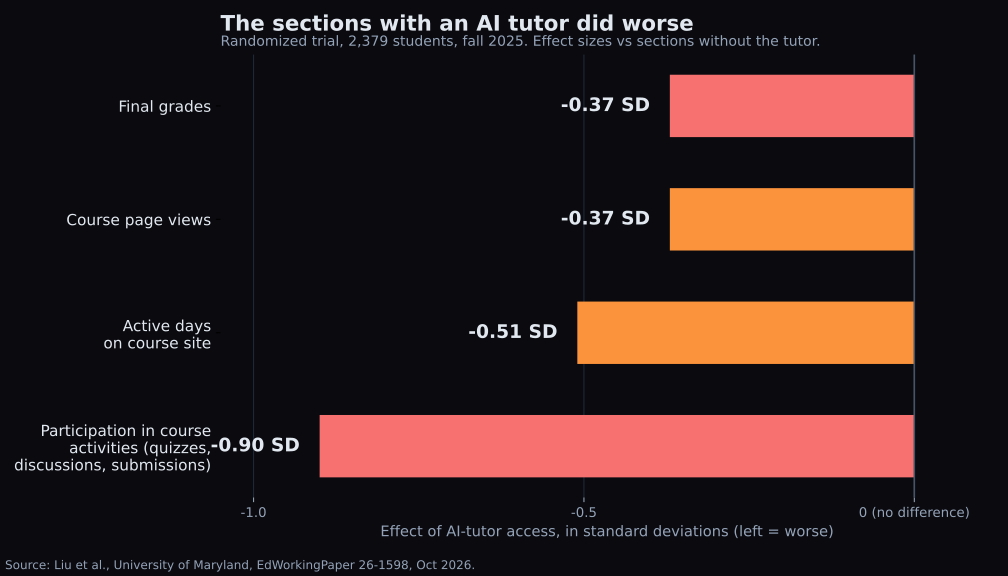
Sections with the AI tutor finished with final grades 0.37 standard deviations LOWER. In everyday terms, that is a solid step down the grade ladder, not noise. And students in those sections used the real course materials much less: recorded participation in the course's own activities - discussions, submissions, quizzes - dropped 0.90 standard deviations, page views fell 0.37, active days fell 0.51. [1]
One group got hit hardest: students who are the first in their family to attend university. Their grade losses were more than twice those of classmates whose parents went to college. The students who could least afford the loss absorbed the biggest one. [1]
Why did a helpful tool hurt?
The usage logs tell the story. About 74% of what students asked the tutor was answer-seeking - give me the information, the explanation, the solution. About 11% was practice or test preparation. Under 1% asked the tutor to check their own work. Students used it to skip the hard part, not to do the hard part better. Learning lives in the hard part. [1]
The researchers are careful about the explanation: some substitution is fine (asking the tutor instead of hunting for logistics). But participation fell in the activities where learning actually happens. Their summary: the tutor displaced engagement with the course instead of adding to it. [1]
Fair warnings
- This is a working paper, not yet peer-reviewed. The authors say so themselves and share the data openly. [1]
- It is one university, one semester, one tutor design. Only about 15% of students in tutor sections ever used it, and students on both sides could use ChatGPT and Gemini anyway. A better-designed tutor might do better. [1]
- Other studies have found AI can help short-term performance. The honest reading is not "AI tutors are bad" - it is "handing students an answer machine does not teach them." [1]
The crutch-or-coach rule
The difference between AI that helps you learn and AI that helps you sink is one question: does it do the hard part for you, or does it make you do the hard part? Under 1% of students asked the tutor to check their own attempts. That 1% had the right idea. [1]
What to do with this
- If you study: after the AI explains, close the chat and redo the problem yourself. If you cannot, the explanation was entertainment, not learning.
- If you teach or manage: measure engagement, not just satisfaction. People love tools that remove effort. That is exactly the problem.
- If you parent: "Did you ask it to check your work, or to do your work?" is the new "did you finish your homework?"
Try it this week
Next time you ask AI to explain something, ask it to quiz you afterwards instead. One question at a time, no peeking. Two minutes of that is worth twenty minutes of nodding along.
We use AI to help write these posts, and we say so on every one: this post was written with AI help and reviewed by a person.
Has AI helped you actually learn something - or just get it done? Tell us on Instagram @velocity11ai.
Source
[1] Liu, Sweet, Chen, Engelberg, Clark, Persaud, Lancaster, Hollingsworth, King Rice, Masters, "The Effects of Course-Integrated AI Tutoring on Student Performance and Engagement: A Randomized University Trial", EdWorkingPaper 26-1598, University of Maryland, Oct 2026. doi.org/10.26300/y3f8-vh05
The hero image was made with AI. The chart was drawn by Velocity11 from the published numbers. This post was written with AI help and reviewed by a person.